Delving into Laura Alunni's Inspirations — An Interview

In a recent interview recorded in her Perugia atelier, Laura Alunni speaks with rare clarity about the forces that have shaped her artistic research over four decades. What emerges is not a biography of success, but something more honest: a portrait of an artist who learned to trust collapse.
Asked how a rigorous classical training could coexist with work that "makes chaos happen", Laura gives an answer that reframes the question entirely:
"Non stanno insieme — si nutrono."("They don't coexist — they feed each other.")
She describes how, beginning in the 1980s in Perugia, she once believed she had to choose between technical control and expressive freedom. It took years to understand she was asking the wrong question. Like a musician who improvises from mastery — not ignorance — her classical formation was never the opposite of her current work. "Forse è la condizione che lo rende possibile." ("Perhaps it is the condition that makes it possible.")
Between 2021 and 2024, Laura stopped exhibiting. Not out of fear or block, she clarifies, but out of something more precise: a growing distance between what she knew how to do and what she felt. Rather than continue producing work that was "tecnicamente corretto ma internamente morto" ("technically correct but internally dead"), she stopped.
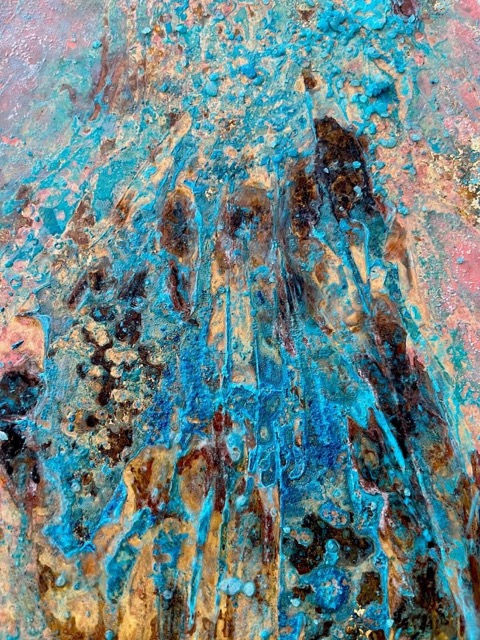
What happened in the studio during those years became the foundation of everything that followed. Materials collapsing on the canvas, oxidants going where she hadn't intended, reactions she hadn't planned — what she read as failure turned out to be the direction she had been searching for years, "senza saperlo nominare" ("without knowing how to name it").
"Entropy non è nata da un'intuizione felice una mattina in studio. È nata da tre anni di resistenza e cedimento alternati."("Entropy was not born from a happy intuition one morning in the studio. It was born from three years of alternating resistance and surrender.")
This is when she encountered — as a concept before a word — the second law of thermodynamics: everything tends naturally toward disorder, nothing keeps the form it had. "Non voglio rappresentarlo. Lo voglio usare." ("I don't want to represent it. I want to use it.")
Her choice of materials — oxidants, wax, worn fabrics — is not aesthetic. She chose them because they force her to relinquish control: "Sto avviando un processo che poi non posso più fermare né correggere." Like a choreographer who sets the initial conditions of a dance, and then the dance does what it wants.
Her canvases deliberately have no frame. "Una cornice dichiara che il processo è terminato. Il mio non termina — l'entropia non si ferma, e nemmeno le mie superfici." ("A frame declares that the process is over. Mine does not end — entropy does not stop, and neither do my surfaces.")
Asked what forty years of practice have revealed, her answer is disarming in its honesty: "Che la domanda tiene." ("That the question holds.") No definitive answers — only forty years of attempts and collapses, and the reassurance that the question is still there, intact.
To watch the full interview, follow the link


Comments